Teaching
Dynamic Causal Modelling for M/EEG
Dynamic Causal Modelling (DCM) is a modelling framework based on an idea originally developed for fMRI, in which measured data are explained by a network model consisting of a few sources which dynamically interact with one another. Through DCM, one can invert this network model through a Bayesian framework, allowing us to make inferences about connectivity between sources in the network and how these connections may be modulated by external input, for example, by task stimuli. This is known as effective connectivity.
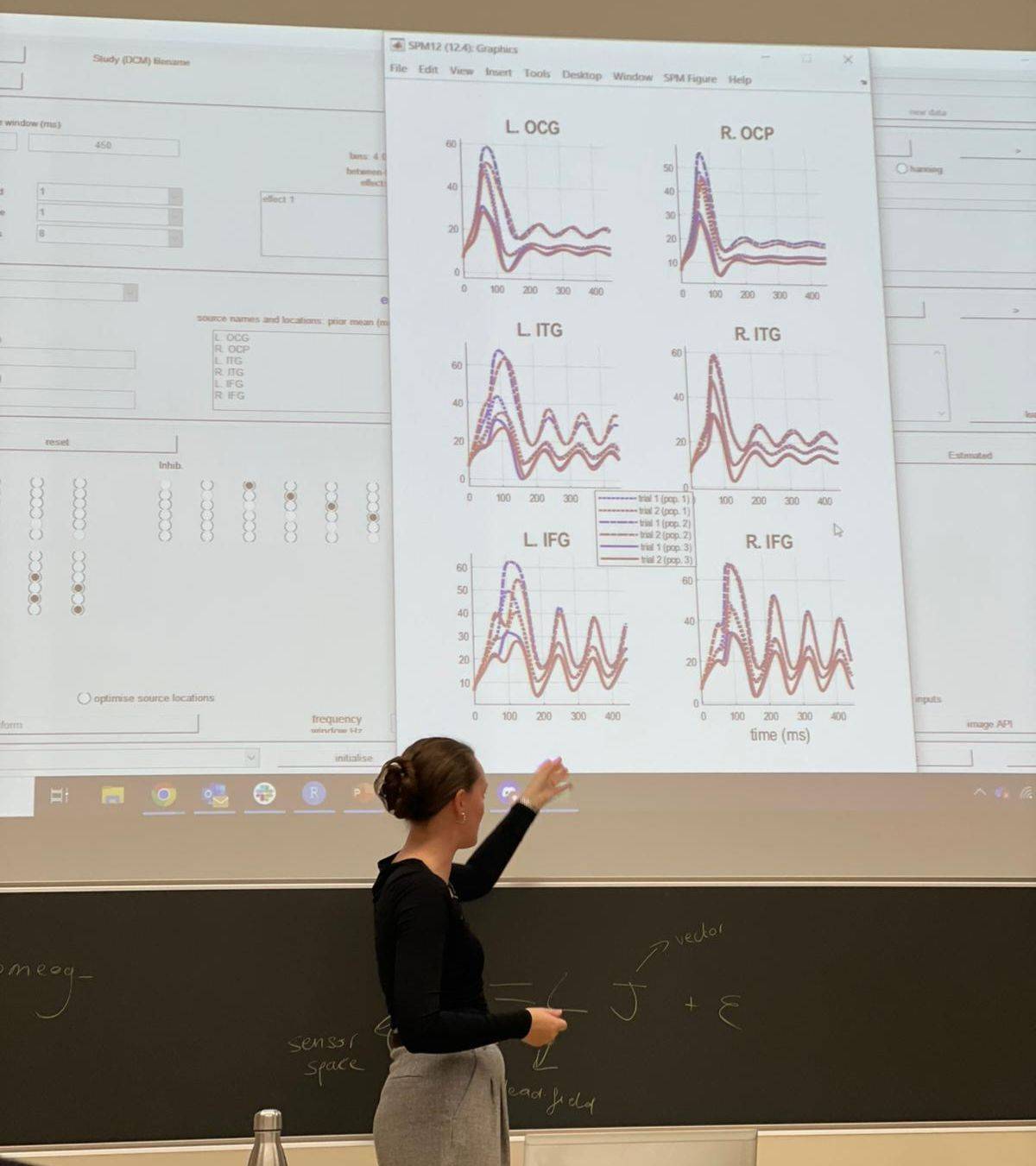
I am an expert in DCM for evoked responses in MEG and EEG data, and I regularly teach the theoretical foundations and practical implementations of this framework. I continue to share my expertise in this biophysical modelling framework in lectures, tutorials, and workshops across the globe and in online resources. I regularly teach DCM for Evoked Responses at the annual SPM12 Course for EEG & MEG and the Computational Psychiatry Course, ETH Zürich.
I also contributed my knowledge of DCM to the Organisation for Human Brain Mapping 'How-To Series', providing a user-friendly online tutorial for specifying and estimating your own DCM. Click the thumbnail below to watch the free tutorial:
Fundamental Biomedical Signal Processing
In 2026, I will teach Fundamental Biomedical Signal Processing in collaboration with the Sino-Danish Centre for Education and Research. My lectures will cover a range of topics, from Fourier Series to filtering and time-frequency analyses.